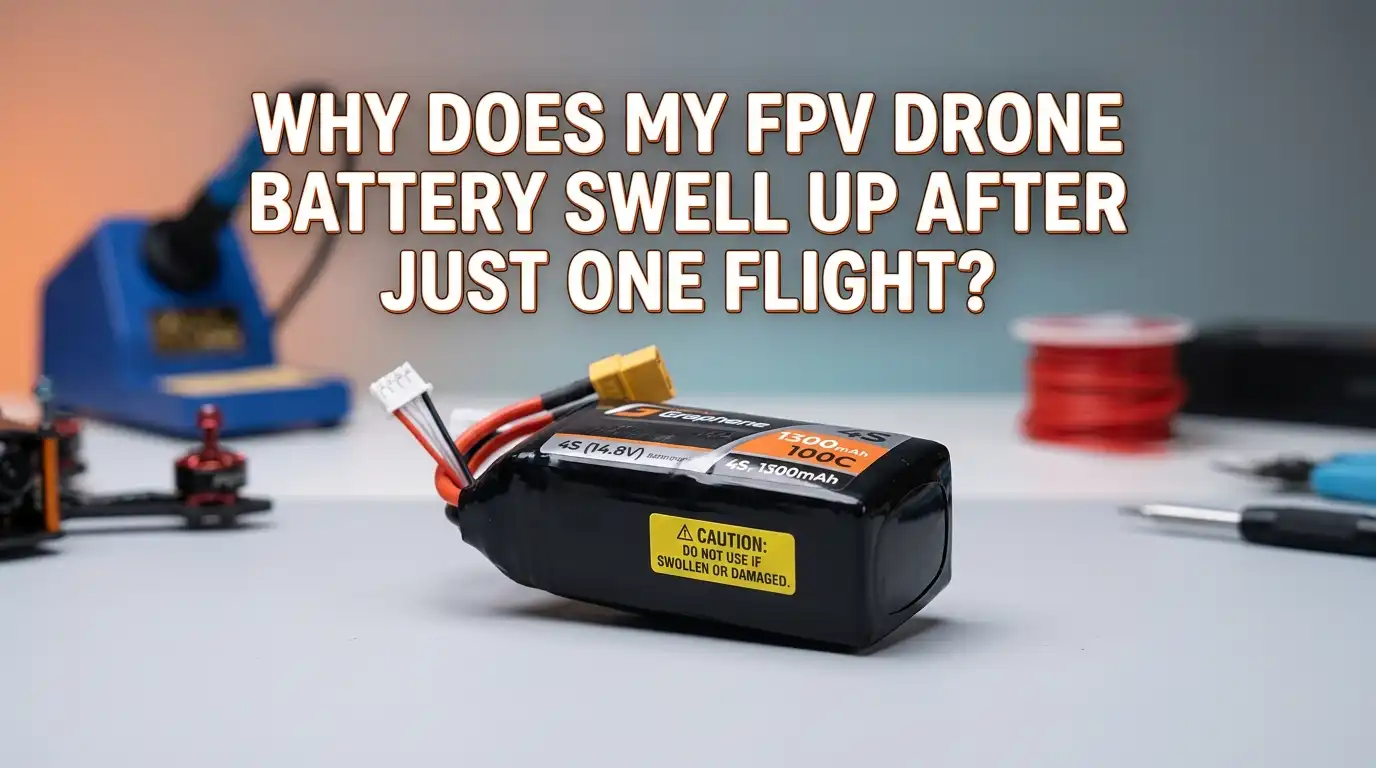
Why Does My FPV Drone Battery Swell Up After Just One Flight?
You just landed your FPV drone after a single flight, and something looks wrong. The battery pack feels soft, puffy, and slightly inflated like a tiny pillow.
Your stomach drops because you know this is not normal. A swollen LiPo battery is one of the most common and alarming problems FPV pilots face. The worst part? It can happen after just one flight, even with a brand new pack.
Battery swelling is not just a cosmetic issue. It signals internal chemical damage that can lead to reduced performance, shorter flight times, and in serious cases, a fire.
In a Nutshell
- Over discharging is a top cause. Flying your battery below 3.5V per cell damages the internal cell structure. This damage creates gas, which causes the pouch to puff up. Always land before your voltage drops too low.
- Heat destroys LiPo batteries fast. Pushing your drone hard with full throttle runs or flying on a hot day generates extreme heat inside the pack. That heat accelerates chemical breakdown and gas production. Cooling your battery before charging is essential.
- Charging mistakes cause immediate swelling. Using the wrong charger settings, skipping balance charge mode, or charging at too high of a rate can overload the cells. This can cause puffing on the very first charge cycle after a flight.
- Manufacturing defects exist. A small percentage of LiPo batteries have internal flaws from the factory. A defective cell can swell after its first use, even if you did everything right. This is why buying from reputable brands matters.
- Physical damage from crashes is a hidden trigger. A hard impact can shift or crack internal cell layers. The battery might look fine on the outside but have serious damage inside that shows up as swelling after your next flight or charge.
- A swollen battery cannot be fixed. Once a LiPo has puffed, the internal damage is permanent. The only safe option is to stop using it, isolate it safely, and dispose of it properly.
What Actually Happens Inside a Swollen LiPo Battery
A LiPo battery uses thin layers of lithium polymer cells sealed inside a flexible pouch. These layers include a cathode, an anode, and a separator soaked in a liquid electrolyte. During normal use, lithium ions move between these layers to store and release energy.
When something goes wrong, the electrolyte breaks down and produces gas. This gas has nowhere to escape because the pouch is sealed. The pressure builds, and the battery starts to puff and expand. Think of it like a sealed bag of chips at high altitude. The gas inside pushes outward.
This process is called electrolyte decomposition. It happens faster under stress from heat, overcharging, over discharging, or physical damage. The more gas that builds, the more unstable the battery becomes. A slightly puffy battery is already damaged. A very puffy battery is a serious fire risk.
Over Discharging Your Battery During Flight
This is one of the most common reasons a new FPV pilot sees a swollen battery after a single session. FPV drones pull enormous current from LiPo packs. A typical 5 inch quad can draw over 100 amps at full throttle. That drains the battery fast.
The safe minimum resting voltage for a LiPo cell is around 3.5V. Going below 3.0V per cell can cause permanent and irreversible cell damage. Many new pilots push their flight time too far. They ignore low voltage warnings or fly until the drone falls out of the sky.
Even one deep discharge can trigger swelling. The internal copper current collector can dissolve at very low voltages. This creates tiny metallic deposits that can short circuit the cell layers. That short circuit generates heat and gas.
Pros of using a low voltage alarm or OSD voltage display: Easy to monitor, cheap to set up, prevents deep discharge.
Cons: Requires discipline to actually land on time. OSD readings can be slightly delayed under heavy load.
Excessive Heat from Aggressive Flying
Heat is the number one killer of LiPo batteries. FPV freestyle and racing involve high throttle bursts, rapid direction changes, and sustained power demands. All of this generates significant heat inside the battery pack.
Internal battery temperatures can spike well above safe limits during an aggressive flight. If you touch your battery right after landing and it feels very hot to the touch, you are pushing it too hard. Temperatures above 60°C (140°F) accelerate chemical breakdown inside the cells.
Flying on hot summer days makes this worse. The ambient temperature adds to the heat generated by the discharge. A battery that might survive a hard flight in cool weather could swell in the same conditions on a 95°F day.
Pros of flying with a lighter throttle hand: Battery lasts longer, stays cooler, and retains health over more cycles.
Cons: Less aggressive flying style may not suit racing or freestyle goals.
Charging Errors That Cause Immediate Swelling
Your charging habits have a direct impact on battery health. Several common mistakes can cause a battery to swell after just one charge and flight cycle.
Charging at too high of a C rate is a frequent issue. The recommended charge rate for most LiPo batteries is 1C. For a 1300mAh battery, that means 1.3 amps. Charging at 2C or higher puts extra stress on the cells and generates heat. Some batteries support fast charging, but many budget packs do not.
Skipping balance charge mode is another mistake. Balance charging monitors each cell individually and keeps them at equal voltage. Without it, one cell can overcharge past 4.2V while another stays low. An overcharged cell produces gas and swells.
Charging a hot battery right after a flight is also dangerous. Always let your battery cool to room temperature before plugging it into the charger. Charging a warm pack pushes it past safe thermal limits.
Pros of always using 1C balance charge: Safest method, extends battery life, keeps cells balanced.
Cons: Slower charging time, which can be frustrating at the field.
Manufacturing Defects and Low Quality Batteries
Sometimes you do everything right, and the battery still swells after one flight. This points to a manufacturing defect. Flaws in the cell assembly process can create weak spots in the separator layer. These weak spots can fail under the stress of a single high current discharge.
Budget batteries from unknown brands are more likely to have these issues. Quality control varies widely across manufacturers. A battery that costs half the price of a reputable brand often cuts corners in materials and assembly.
Reputable brands like GNB, CNHL, Tattu R Line, and Lumenier invest in better quality control. Their cells are more consistent, and their pouches are better sealed. This does not make them immune to defects, but it reduces the odds significantly.
Pros of buying from trusted brands: Better consistency, lower defect rates, more reliable performance.
Cons: Higher upfront cost per battery.
Physical Damage from Crashes You Did Not Notice
FPV drones crash. That is part of the hobby. But crashes can damage your battery in ways that are not visible on the outside. A hard impact can compress the internal cell layers, crack the separator, or shift the electrodes.
This internal damage may not show symptoms right away. The battery might fly fine for one more session. But during the next charge cycle, the damaged area generates gas. You pull the battery off the charger and notice it has puffed up.
Always inspect your battery after a crash. Look for dents, bends, or soft spots in the pouch. Press gently on the flat surfaces. A healthy battery feels firm and uniform. A damaged one may feel soft or uneven in certain areas.
Pros of inspecting batteries after every crash: Catches damage early, prevents dangerous swelling during charging.
Cons: Takes extra time, and some damage is impossible to detect by touch alone.
How to Check if Your Swollen Battery Is Still Safe
The short answer is that a swollen battery is never truly safe. Any amount of puffing indicates internal gas buildup from chemical damage. That said, some pilots distinguish between slight puffing and severe swelling.
A battery with very minor puffing after many charge cycles may still hold voltage and fly. However, this is a risk assessment that each pilot must make individually. The safest recommendation is to retire any battery that shows swelling.
Check the cell voltages using a battery checker or your charger’s display. If any cell is significantly lower than the others, or if the total voltage is unusually low, the battery has internal damage. Do not attempt to charge a battery that reads below 3.0V per cell. This can cause a thermal runaway event.
Pros of retiring swollen batteries immediately: Maximum safety, no risk of fire.
Cons: Higher cost from replacing batteries more often.
Step by Step Guide to Safe LiPo Storage
Proper storage prevents many of the issues that lead to swelling. A battery stored incorrectly can degrade even without being used. Here is what you should do after every flying session.
Step 1: Let your batteries cool to room temperature after flying. Do not charge them while they are still warm from use.
Step 2: Use your charger’s storage charge mode to bring each cell to approximately 3.80V to 3.85V. This is the most stable resting voltage for a LiPo cell.
Step 3: Place your batteries in a fireproof container. A metal ammo can or a dedicated LiPo safety bag works well. Store them in a cool, dry location away from direct sunlight and heat sources.
Step 4: Never store batteries at full charge (4.2V per cell) or fully depleted. Both extremes accelerate chemical degradation and increase the chance of swelling over time.
Pros of proper storage habits: Extends battery lifespan, reduces swelling risk, improves safety.
Cons: Requires an extra step after each session, and storage mode takes time on the charger.
What to Do Immediately with a Swollen Battery
If you discover a puffy battery, stop using it right away. Do not try to fly it one more time. Do not try to charge it. The battery has failed internally, and continued use increases the fire risk.
Place the swollen battery in a LiPo safe bag, metal ammo can, or a metal bucket with sand. Move it to an outdoor area away from anything flammable. A concrete patio or bare dirt patch is ideal.
Do not puncture the battery to release the gas. This is extremely dangerous. The gas inside is flammable, and exposing the internal chemistry to air and moisture can cause an immediate fire. Some online forums suggest this method, but it is a serious safety hazard.
Monitor the battery for changes. If it continues to swell, produces a sweet chemical smell, or feels warm, move further away and call your local fire department if it starts smoking.
How to Safely Dispose of a Swollen LiPo Battery
You cannot throw a swollen LiPo battery in your regular trash. It is a fire hazard for sanitation workers and landfill equipment. Proper disposal is your responsibility as a pilot.
Step 1: If the battery still holds charge, discharge it slowly to 0V using a LiPo discharger, a low wattage light bulb, or your charger’s discharge mode. Do this outdoors in a fireproof container. Monitor it the entire time.
Step 2: Once discharged to 0V, the battery is much safer to handle. Some recycling guidelines suggest submerging the discharged battery in salt water for 24 hours to ensure full depletion. However, this method has mixed opinions in the community.
Step 3: Take the fully discharged battery to a battery recycling center, hazardous waste facility, or an electronics store that accepts battery drop offs. Many locations accept LiPo batteries at no cost.
Pros of the light bulb discharge method: Simple, cheap, effective.
Cons: Must be monitored constantly, and a damaged battery may behave unpredictably during discharge.
Choosing the Right Battery to Avoid Future Swelling
Your battery choice plays a big role in how long your packs last and how likely they are to swell. Picking the right capacity, C rating, and brand makes a measurable difference.
Match your battery capacity to your drone’s weight class. A 5 inch freestyle quad on 6S typically uses a 1050mAh to 1300mAh pack. Using a battery that is too small forces it to discharge at rates beyond its safe limits. This generates heat and shortens its life.
Check the C rating against your drone’s current draw. Your four motors at full throttle determine the peak current demand. The battery’s C rating multiplied by its capacity should exceed this peak demand. A battery that cannot keep up will overheat and swell.
Stick with reputable brands. GNB, CNHL, Tattu, and Lumenier are well known in the FPV community for consistent cell quality. A cheaper no name battery may save money upfront but cost more in replacements.
Pros of investing in quality batteries: Longer lifespan, less swelling, better performance.
Cons: Higher initial cost per pack.
Best Practices to Prevent LiPo Battery Swelling
Prevention is always easier and cheaper than dealing with a swollen pack. Here is a summary of the best habits every FPV pilot should follow.
Always balance charge at 1C. This is the gentlest method and keeps all cells even. Let the battery cool completely before charging. Never charge unattended. Stay in the room and check the battery temperature periodically.
Land before your voltage drops below 3.5V per cell. Set up a low voltage alarm in your OSD or use an external buzzer. Flying until your quad drops from the sky is the fastest way to kill a battery.
Inspect every battery before and after each flight. Look for puffing, dents, nicks, and damaged connectors. Store all batteries at storage voltage (3.80V to 3.85V per cell) in a fireproof container. Never leave batteries fully charged for more than a day or two.
Avoid flying in extreme heat. If the ambient temperature is above 35°C (95°F), your batteries are already starting at a disadvantage. Give them extra cool down time between flights.
Frequently Asked Questions
Is it normal for a LiPo battery to puff slightly after flying?
A very slight, barely noticeable puff can occur under heavy load, and some batteries return to normal after cooling. However, any persistent swelling is a sign of internal damage. If the battery stays puffy after cooling down, treat it as a failed pack and stop using it.
Can I fix a swollen FPV drone battery?
No. A swollen LiPo battery has permanent internal damage. The gas inside is a result of electrolyte decomposition, and this process cannot be reversed. Never puncture, squeeze, or attempt to deflate a swollen battery. The only safe course of action is to dispose of it properly.
How do I know if my charger caused the swelling?
If the battery swelled during or immediately after charging, your charger settings may be the cause. Check that you used the correct voltage setting (4.2V per cell for standard LiPo), the correct cell count, and a charge rate of 1C. A malfunctioning charger can also overcharge cells. Investing in a quality smart charger with balance charging is the best prevention.
What voltage should I store my FPV batteries at?
Store your LiPo batteries at approximately 3.80V to 3.85V per cell. Most modern chargers have a dedicated storage charge mode that brings each cell to this level automatically. Never store batteries at full charge or fully depleted for extended periods.
How many flights should a LiPo battery last before swelling?
A well maintained LiPo battery from a reputable brand should last 200 to 300 charge cycles before showing significant wear. If your battery swells after just one flight, the cause is likely over discharging, a charging error, crash damage, or a manufacturing defect. Proper care dramatically extends battery life.
Can I fly with a slightly puffy LiPo battery?
This is a personal risk decision, but the safest answer is no. A puffy battery has compromised internal chemistry. It may still hold voltage and deliver power, but the risk of further swelling, reduced performance, or fire increases with each use. Most experienced FPV pilots retire puffy packs immediately.
Hi, I’m Rosie Tate — a tech enthusiast, gadget geek, and the creator of RapidConvertLab! 🚀 I’ve spent years exploring the ever-evolving world of electronics, smart devices, and Amazon’s hidden tech treasures. Through my honest, hands-on reviews, I help everyday shoppers cut through the noise and pick gadgets that truly deliver value. When I’m not testing a new device, I’m probably unboxing one! 📦✨