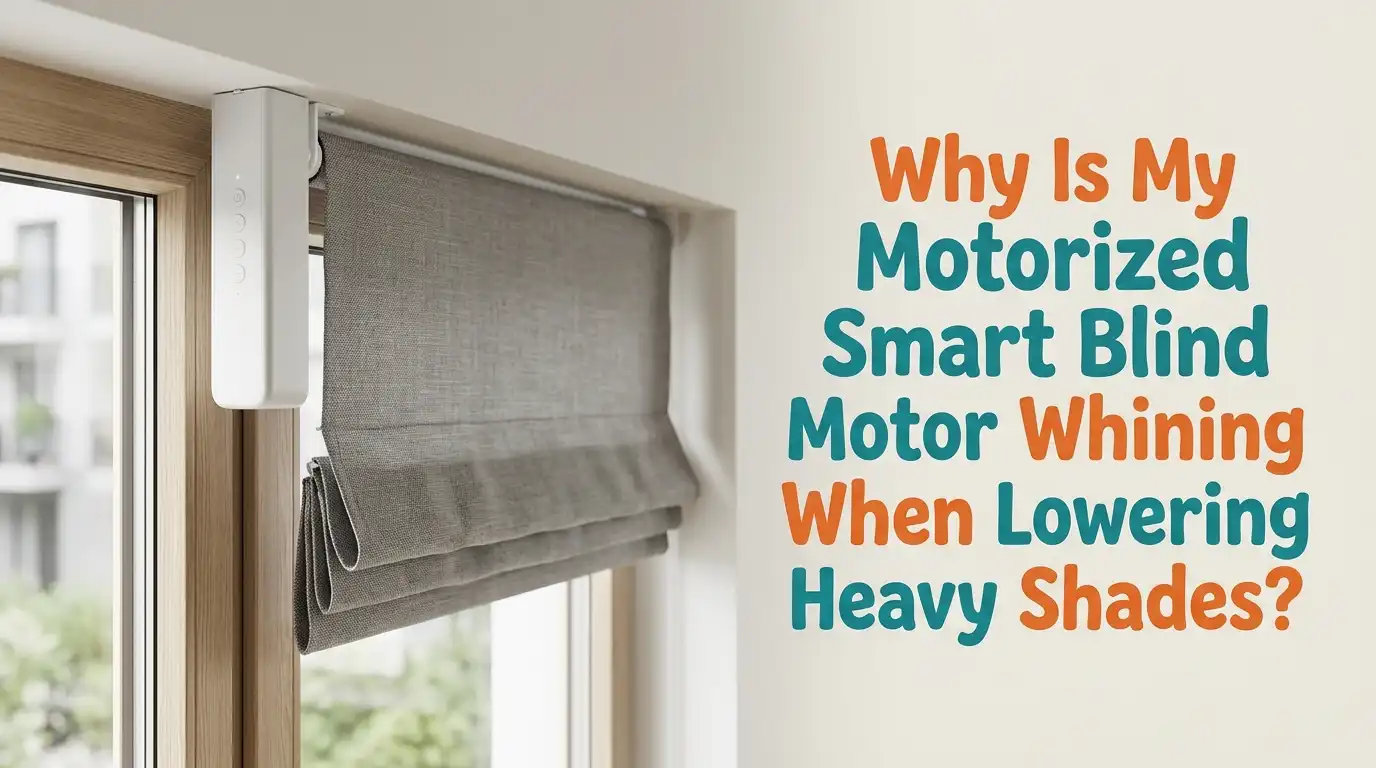
Why Is My Motorized Smart Blind Motor Whining When Lowering Heavy Shades?
That high pitched whine from your smart blind is hard to ignore. You tap the button, the heavy shade starts to drop, and the motor screams the whole way down. It feels like the motor is begging for help.
The good news is that this sound usually points to a fixable problem, not a dead motor. A whine almost always means the motor is working too hard or fighting friction it should not have to fight.
In this guide, you will learn exactly why your motor whines under heavy shades. You will get clear, step by step fixes you can try today. You will also see the pros and cons of each solution, so you can pick the one that fits your time and budget.
In a Nutshell:
- A whine means strain, not always failure. The motor pulls hard against weight, friction, or gravity. The sound is a warning sign, but the motor is often still healthy.
- Heavy fabric is the most common trigger. Blackout and thermal shades weigh a lot. If your motor torque rating sits below the load, the motor strains and whines on every drop.
- Friction multiplies the problem. Dry brackets, a bent tube, or a crooked roll add resistance. Clean and align parts before you blame the motor itself.
- Limit settings and calibration matter. Wrong stop points force the motor to push past where it should. Recalibrating often removes a sudden whine.
- Overheating causes slow, painful sounds. Frequent use heats the motor, and the thermal cutoff kicks in. Rest the motor and the whine often fades.
- Replacement is the last step. Grinding, clicking, and stalling mean true wear. A simple whine rarely needs a new motor right away.
What the Whining Sound Is Actually Telling You
A whine is the sound of a motor under load. The internal gears spin fast, and the motor draws extra current to move the weight. When the load matches the motor strength, you hear a soft, even hum. When the load is too high, that hum climbs into a sharp whine.
Think of it like a person carrying a heavy box up stairs. Light box, easy steps, quiet breathing. Heavy box, strained legs, loud grunting. Your motor does the same thing. The pitch tells you how hard it works.
A steady whine on heavy shades points to load and friction. A grinding or clicking sound is different and more serious. Learn to tell these apart, because the fix for each is not the same.
Heavy Shade Fabric Pushes Your Motor Past Its Limit
Heavy fabric is the number one cause of motor whine. Blackout shades, thermal liners, and wide fabric rolls weigh far more than light filtering material. Your motor has a fixed torque rating, and heavy fabric can sit right at or above that limit.
Most tube motors carry a torque rating in newton meters, often written as Nm. For wide spans over eight feet, experts suggest at least 1.1Nm to 2.0Nm. If your shade is wide and heavy but your motor sits at the low end, the motor strains hard. That strain becomes a whine.
To check this, weigh or estimate your shade. Then find your motor torque rating in the manual. If the load sits near the top of the rating, the whine makes sense.
Pros of matching torque to load: The motor runs quiet, lasts longer, and lifts smoothly.
Cons: A higher torque motor costs more, and swapping it takes effort and sometimes a pro.
Friction Inside the System Makes the Motor Work Harder
Friction is the hidden enemy. Even a strong motor whines if something rubs or sticks. Heavy shades press harder on every contact point, so any friction grows worse under weight.
Check the brackets first. Dry metal on metal rubbing adds drag. Look at the end caps and idler on the far side of the tube. A tight or misaligned idler fights the motor on every drop.
Next, look at how the fabric rolls. A crooked or loose roll bunches up on one side. This forces the motor to pull unevenly. The result is a whine that may rise and fall as the shade moves.
Pros of fixing friction: It is free, fast, and often solves the whine completely.
Cons: You must remove and inspect parts, which takes patience and a steady hand.
Step by Step: How to Lubricate the Moving Parts Safely
Lubrication is one of the easiest fixes. The right lubricant cuts friction and quiets squeaks fast. Use a silicone based spray, never a thick oil or grease. Thick lubricants attract dust and gum up the works.
Follow these steps. First, power off the shade or remove the battery. Second, wipe down the brackets, end caps, and idler with a dry cloth. Third, spray a light mist of silicone spray on the moving contact points only. Fourth, wipe away any excess so it does not drip on the fabric.
Keep the spray away from the motor body and any electronics. Lubricant inside the motor can damage it. Run the shade a few times after spraying to spread the coating evenly.
Pros: Cheap, quick, and safe when done right. It often kills the whine in minutes.
Cons: It is a temporary fix if the real problem is weight or worn gears.
Recalibrate the Limits to Stop the Motor From Straining
Wrong limit settings make a motor push past where it should stop. The motor reaches the true bottom, but the program tells it to keep going. That extra push creates a loud, sudden whine at the end of travel.
Recalibration resets the top and bottom stop points. The exact steps vary by brand, but the idea stays the same. Move the shade to the position you want. Then hold the program or set button, usually for about five to eight seconds, until the motor responds with a beep or jog.
Set the new bottom limit at the real bottom of the shade. Set the top limit at the real top. Test the full travel twice to confirm the whine is gone at the ends.
Pros: Free, fast, and fixes whines that appear only at the start or end of travel.
Cons: You must find your brand instructions, and the process feels fiddly the first time.
Check the Roller Tube for Bowing or Deflection
A bowing tube is a clear sign your fabric is too heavy for the support. Heavy shades push down on the center of the tube. If the tube sags in the middle, the fabric rolls unevenly and the motor strains hard.
Look at the tube when the shade is half down. A straight tube is healthy. A tube that dips in the center tells you the load exceeds the tube strength. This deflection adds friction and forces the motor to fight on every drop.
The fix often means a larger diameter or stronger tube. A wider tube resists bowing and rolls the fabric more evenly. Some systems use a center support bracket to take the load off the middle.
Pros of a stronger tube: It removes the strain at the source and stops the whine for good.
Cons: It costs money, and you may need to rebuild the whole shade assembly.
Why Overheating Causes Slow, Whining Movement
Motors heat up with frequent use. If you raise and lower the shade many times in a short window, heat builds inside the motor. A built in thermal cutoff then slows or stops the motor to protect it.
A hot motor often whines because it loses power. It still pulls the shade down with gravity, but it strains the whole way. The sound feels slower and more labored than a normal whine. You may also notice the shade stops halfway or refuses to go back up.
The fix is simple. Stop using the shade and let the motor rest for fifteen to thirty minutes. Once it cools, the motor should run quiet again. If overheating happens often, your motor may be undersized for the load.
Pros: Resting the motor is free and prevents damage.
Cons: Frequent overheating signals a deeper torque mismatch that needs a real fix.
Inspect the Fabric Roll for Uneven Winding
An uneven roll forces the motor to work harder on one side. Heavy fabric is stiff and less forgiving. When it winds crooked, the layers bunch up and create drag and pressure points.
To check, lower the shade fully and watch how it rolls back up. A clean roll wraps tight and even across the tube. A bad roll telescopes to one side or builds a thick lump. This imbalance makes the motor whine as it fights the uneven pull.
Fix it by rolling the fabric back onto the tube tightly and evenly by hand. Make sure the fabric sits square to the tube. A small adjustment to the bracket level can also straighten the roll.
Pros: Free and quick, and it often smooths out both noise and creasing.
Cons: Severe winding problems may point to a tube or bracket alignment issue that needs more work.
Tighten Loose Brackets, Screws, and Mounting Hardware
Loose hardware causes vibration, and vibration sounds like a whine or buzz. Heavy shades shake the mounting more than light ones. A loose bracket lets the whole assembly rattle against the wall or window frame.
Walk through every fixing point. Tighten the mounting screws that hold the brackets to the wall. Check the screws on the end caps and the motor head. Confirm the tube sits firmly in both brackets with no play.
Press your hand against the headrail while the shade moves. If the noise drops when you steady it, loose mounting is your culprit. Some people add foam tape between the bracket and frame to dampen the buzz.
Pros: Free, fast, and a common fix that many people overlook.
Cons: It only helps if vibration is the cause, not raw motor strain.
When the Motor Hums but the Shade Will Not Move
Sometimes the motor hums or whines but the shade stays still. This means the motor gets power but cannot move the load. The motor is mechanically stuck. This is different from a normal lowering whine and needs careful checking.
First, look for obstructions in the roller tube or along the fabric path. A jammed object or twisted fabric can lock the system. Second, check that the motor connector and battery are seated and charged. A weak battery gives just enough power to hum but not to move.
If the path is clear and power is full but it still only hums, the internal gears may have failed. At this point, the problem moves from simple to serious.
Pros of checking this first: You rule out cheap fixes before spending on a new motor.
Cons: A truly stuck motor with healthy power usually means internal damage.
How to Tell If Your Motor Is Worn Out or Failing
Not every noise is a quick fix. Some sounds mean the motor has real wear. Learn the warning signs so you do not waste time on small fixes when the motor needs replacing.
True failure signs include grinding or clicking sounds, overheating during normal use, no response after a reset, and uneven or jerky movement. A grinding noise points to damaged gears. Clicking often means a slipped or broken internal part.
A simple whine under heavy load rarely means failure on its own. But a whine that turns into grinding, or a motor that stalls and overheats often, tells a different story. Track how the sound changes over a week. A worsening sound means wear.
Pros of knowing the signs: You avoid spending on a motor that still works.
Cons: Some early wear hides behind normal sounds, so diagnosis takes attention.
Comparing Your Repair Options: DIY Versus Professional Help
Once you know the cause, you must choose how to fix it. Most light fixes suit a DIY approach. Bigger fixes may need a pro. Weigh your time, skill, and budget before you decide.
DIY fixes cover lubrication, recalibration, tightening hardware, and rewinding fabric. These cost little and need only basic tools. They solve most whining problems. The risk is low as long as you power off first and avoid spraying near electronics.
Professional help suits motor replacement, tube upgrades, and torque mismatches. A pro brings the right parts and matches the motor to your load. This costs more but removes guesswork. It also protects any warranty on your smart shade system.
Pros of DIY: Cheap, fast, and satisfying when it works.
Cons of DIY: You risk a wrong fix or a voided warranty on complex systems.
How to Prevent the Whining From Coming Back
Prevention saves you from repeat trouble. A few simple habits keep your motor quiet and your shades smooth for years. Build these into your routine.
First, match the motor torque to your fabric weight when you buy or replace shades. Heavy blackout fabric needs a strong motor and a sturdy tube. Second, clean the brackets and lubricate the moving parts once or twice a year with silicone spray.
Third, avoid running the shade up and down many times in a short burst. Frequent cycling heats the motor and shortens its life. Fourth, check the fabric roll now and then to keep it winding straight. Tighten any loose screws the moment you hear a rattle.
Pros of prevention: It saves money and keeps the system silent.
Cons: It takes a little planning and a small amount of upkeep time.
Frequently Asked Questions
Is it normal for my smart blind motor to make some noise?
Yes, a soft and even hum is normal. Most motorized blinds produce around fifty decibels, similar to a quiet refrigerator. A gentle hum during travel is fine. You only need to worry when the sound becomes a sharp whine, a grind, or a click.
Can heavy blackout shades damage my motor over time?
They can, if the motor torque sits below the load. A motor that strains on every drop wears faster and overheats more often. Match the motor strength to the fabric weight to avoid long term damage. A stronger tube also helps spread the load.
What lubricant should I use on noisy roller shades?
Use a silicone based spray. It cuts friction, runs quiet, and resists dust. Never use thick oils or grease, since they attract grime and gum up the parts. Apply a light mist to moving contact points only, and keep it away from the motor and electronics.
Why does my shade go down fine but struggle to go up?
This often points to an overheated or undersized motor. Gravity helps the shade go down, so the motor needs less power. Lifting against gravity needs more torque. If the motor is hot or too weak, it can drop the shade but not raise it.
How do I know if I need a new motor instead of a repair?
Look for grinding, clicking, repeated overheating, or no response after a reset. These point to true wear. A simple whine under heavy load usually does not. Try cleaning, lubrication, and recalibration first. If the noise worsens or the motor stalls, replacement is the next step.
Will recalibrating the limits really stop the whining?
It can, if the whine appears at the very start or end of travel. Wrong limits force the motor to push past its true stop point. Resetting the top and bottom limits removes that extra strain. It will not help if the whine comes from heavy fabric or friction along the whole drop.
Hi, I’m Rosie Tate — a tech enthusiast, gadget geek, and the creator of RapidConvertLab! 🚀 I’ve spent years exploring the ever-evolving world of electronics, smart devices, and Amazon’s hidden tech treasures. Through my honest, hands-on reviews, I help everyday shoppers cut through the noise and pick gadgets that truly deliver value. When I’m not testing a new device, I’m probably unboxing one! 📦✨